Friday, March 22, 2013

Spring is around the corner...


The transformation will soon take place!


Todd and Mick inspect the 13th green.  Green covers will be removed as soon as the weather breaks.


Miguel puts the finishing touches on the tee markers in anticipation of opening day.


Several dangerous trees were identified by our arborist and removed over the winter.  The tree above is an example of a hollowed trunk, potentially dangerous in a wind storm.
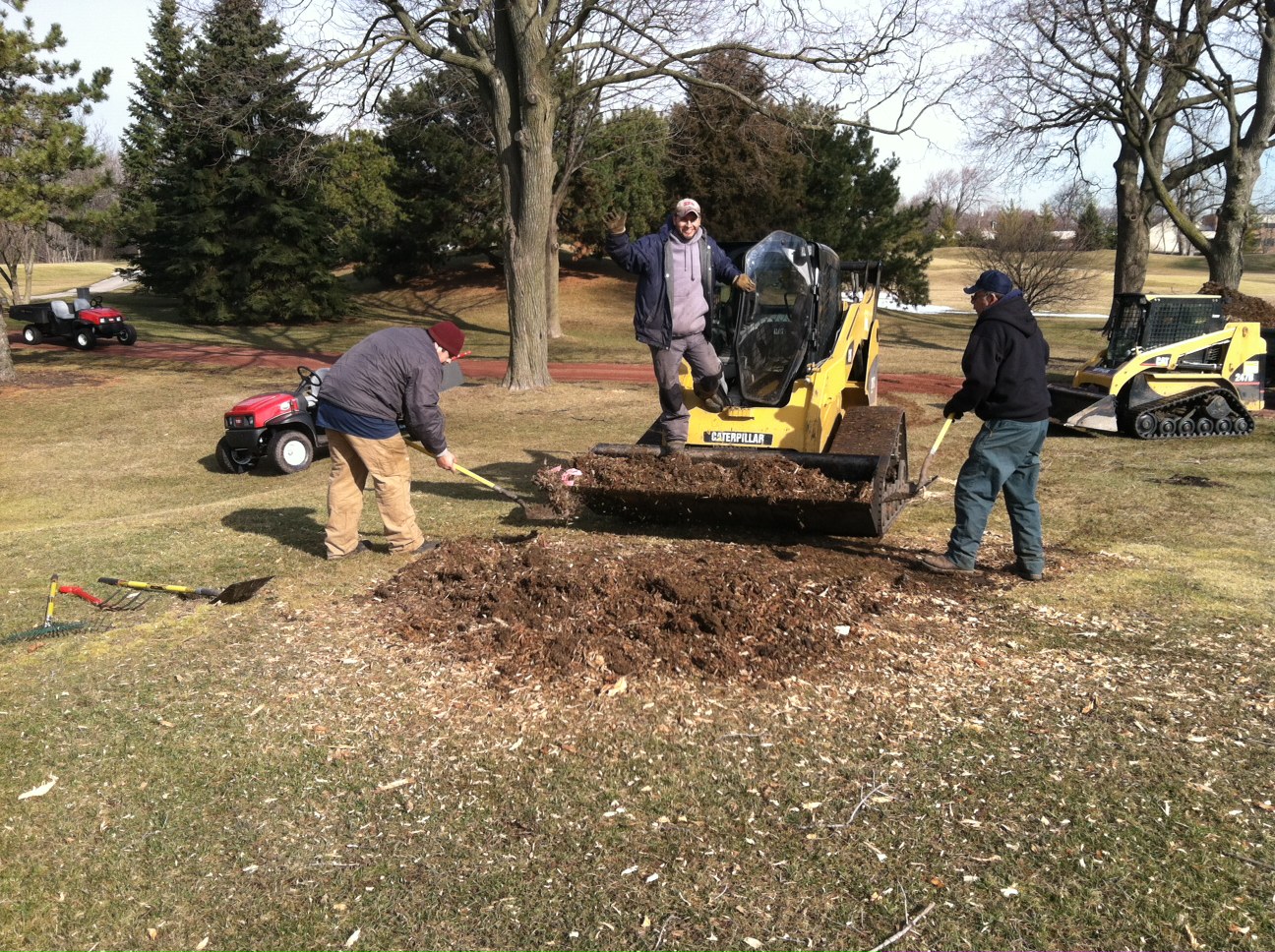

Juan, Cruz and Benito work on stump removal during a sunny afternoon.  Frozen ground allows us to use larger equipment without damaging the dormant turf.


Todd hauls trunk pieces to our storage area near the 4th hole.  Later this wood will be split and seasoned for firewood.


Wood chips and stump grindings are stockpiled before being hauled off site.  These chips and grindings will be recycled for mulch and compost.


Tuesday, February 5, 2013

Winter Maintenance


Green covers are in place on select greens while other greens have been protected with a chemical shield and heavy sand topdressing.  Covered greens must be closely monitored during extreme temperature swings to prevent damage.


With the help of IDOT the "totem poles" behind the first green have been removed.  


Tree trimming and removal is ongoing throughout the winter as weather allows.  Frozen ground allows heavy equipment access to the entire golf course.  The majority of this work is performed using in house labor and equipment. 


Preparing equipment for the upcoming season is a top priority.  Equipment is steam cleaned before undergoing a complete check of all systems.


Our new equipment lift allows for safe access to the underside of equipment.


Cutting reels are removed, rebuilt if necessary and sharpened for the upcoming season.


Tuesday, December 18, 2012

Preparing for Winter

The first step in preparing for spring 2013 is surviving a Chicago winter...


Irrigation Winterization - A large air compressor is connected to the irrigation pump house located behind the 13th green.  Compressed air is forced through all irrigation piping to remove water out which could potentially freeze and damage piping and other irrigation components.


Irrigation Winterization - Compressed air mixed and remaining water is blown through each of our 1200 sprinkler heads and fittings.  The entire blowout process is completed in 2 days.


A final application of plant protectants is applied to greens, tees and fairways to protect against snow mold.  An anti-desicant is also added to protect the plant from winter weather extremes.


A heavy sand topdressing acts as a blanket from winter weather.


Green covers are utilized on select greens to promote further growth, and add another layer of protection in certain microclimates.

Thursday, October 11, 2012

Fall Maintenance


Greens healed quickly after the fall core aerification as evidenced by the ever shrinking holes at the top of this photo.  A fresh channel of sand can be seen in the profile sample near the golf ball.  Continued core aerification will result in less organic matter and healthier greens long term.


Core aerification of tees is complete.  Cores were pulled similar to the greens operation to remove built up organic matter and thatch.  A heavy sand topdressing followed to fill the aerification holes and provide channels for air and water.


The overflow for the pond on #1 shows the continuation of drought conditions.  This pond is not connected to the irrigation reservoir system and is therefore only recharged through natural rainfall.  The pond has remained 18"-24" below it's normal level, not surprising considering Lake Michigan is a full 12" below it's normal level.


Fairway aerification continues with solid tines penetrating 6"-8" into the soil profile.  These tines have a shattering effect which opens channels for water and gas exchange.


A crisp fall morning on the golf course.  Long shadows cover the ground with the sun at a low angle and the trees begin to show their color.  Irrigation and maintenance practices are adjusted accordingly to account for areas that remain shaded throughout the day.

Friday, September 14, 2012

Greens Aerification


Aerificaton is often considered a dirty word around the clubhouse, but it is a necessary evil when it comes to maintaining quality putting greens.  Removal of cores is essential in maintaining a healthy root system through the stresses of summer.  Core removal allows for the removal of built up organic matter in the soil caused by the normal life cycle of the grass plants, and provides channels for air and water to infiltrate the root zone while also reducing compaction.  No hard and fast rule applies to the amount and timing of aerification, but the USGA recommends that 15%-20% of the surface area should be affected each season during a normal maintenance program.  This percentage can be achieved by both tine size, and tine spacing.  This fall, I opted for a 5/8" tine on a 2"x 2" spacing, affecting 10% of the surface area.  The photos below show some of the greens aerification process.


Miguel begins core aerifying on #1 green.  Each green takes approximately 1 hour to complete with 1 of our 3 machines.


Miguel completing #1 green with a clean up pass around the collar.  Crew members have started to wind-row the plugs in the center of the green for removal.


Wind-rows of plugs are removed by hand, and clean topdressing sand is worked into each hole using brooms and blowers.


Finally greens are fertilized and rolled in preparation for play.  I expect the healing process to be complete in 10-14 days.


Collar Sodding

Traffic, mechanical wear and the heat of summer stressed many of the collars comprised of Poa annua.  Sodding of the damaged areas is underway.


Thin Poa annua collar


Staff removing this sod around collar


New Bentgrass sod from our turf nursery laid in place of Poa annua


Friday, August 17, 2012

14th Green Micro-Climate

Air movement is essential to allow the grass plant to cool itself during hot summer weather.  The 14th green is situated in low area below the maintenance building which receives very little air flow.


This photo is taken standing on the 14th green.  Notice the stiff wind blowing the American Flag in the background, while the flag on the pin is limp.


Irrigation water at 80F has limited cooling ability


Ice is used to cool the air before we blow it across the green.


Portable fans are set up each day to provide some relief.