Wednesday, March 12, 2014

Winter Weather Part II

Following up on our recent blog post and letter to membership, below are some photos of our continued effort to mitigate any winter damage on greens.


After the snow was removed (see previous post) most greens were left encased in a thick layer of compacted snow and ice.  Fertilizer was applied to absorb heat and aid in the meltdown.


After just a few hours the meltdown began.  Mick inspects the 18th green (above), not a goose in sight! 


Staff cut small channels in the ice to aid in drainage of meltwater.  


Thicker ice was broken up by hand.


Skid steers were used to clear snow from the low runoff points at the edge of all greens.  Above you can see meltwater pooling near the edge of the 14th green.  It was important to provide an exit point for meltwater so we didn't reform ice as night time temperatures dipped below freezing.


Throughout the winter small 2" sample plugs have been brought into the shop and placed under a grow light.  So far results have been mixed but the information gained from these samples allows us to build a game plan for the warmer temperatures that are surely around the corner.

Thursday, February 13, 2014

Winter Weather

If you've spent the winter in Chicago I don't need to tell you the weather has been relentless.  From the "polar vortex" to constant snowfall events, sunny days on the golf course seem a long way off.  Of particular interest this winter season is the potential for winter damage to the golf course given the harsh winter weather.  While snow cover is fine and can even provide an insulating blanket to our fine turf, extended periods of ice coverage are another mater.  At this point areas of the golf course have been under continuous ice coverage since a rain event on January 13th.  Expert opinions vary but generally poa annua (our primary grass species) can survive 30-60 days under ice before death begins.  Bentgrass on the other hand can survive 90-120 days under ice coverage before damage occurs which is yet another reason for the re-grassing portion of the upcoming Renovation Plan.

Winter Injury and Turf

Several types of winter injury can occur depending on weather and grass types:  Low temperature kill, snow mold disease, winter desiccation, crown hydration and ice encasement or suffocation to name a few.  Plant protectants applied in the fall do a good job of controlling snow mold.  The covers used in the past provided protection from desiccation injury but do little to protect plants from ice encasement or crown hydration injury which are of particular concern this season.

Our primary turf type is poa annua on greens, tees and fairways.  It is this poa annua that is most concerning as we surpass the 30 day mark under ice cover.  With the long term forecast showing a slight warmup next week I have made the decision to remove the snow from greens and help Mother Nature break up and melt the persistant ice layer.  The beginnings of the process are outlined below, updates to follow next week as the weather warms...


Snow blowers and shovels are used to clear the 18" - 24" of snow from each green on the golf course.  Exposing the ice layer to sunshine and warmer temperatures next week will help speed the thawing process. 


Using a 2" hole saw core samples were removed from several greens.  These samples will be placed indoors in a greenhouse setting as test samples.


Above is a core sample from the 18th green, the ice layer is approximately 3/4" thick.  In 5-7 days we should have a good indicator of how our greens have handled this winter.

Stay tuned.... 

Monday, October 21, 2013

Test Bunkers


Two test bunkers have been constructed at the short game area near the Pro Shop to sample and compare different bunker sands and construction methods.  Below you will find a step by step explanation of a typical bunker rehabilitation proposed in the Renovation Plan.


Bunker sand was removed from 2/3 of each bunker.  The remaining 1/3 was left undisturbed for comparison purposes.


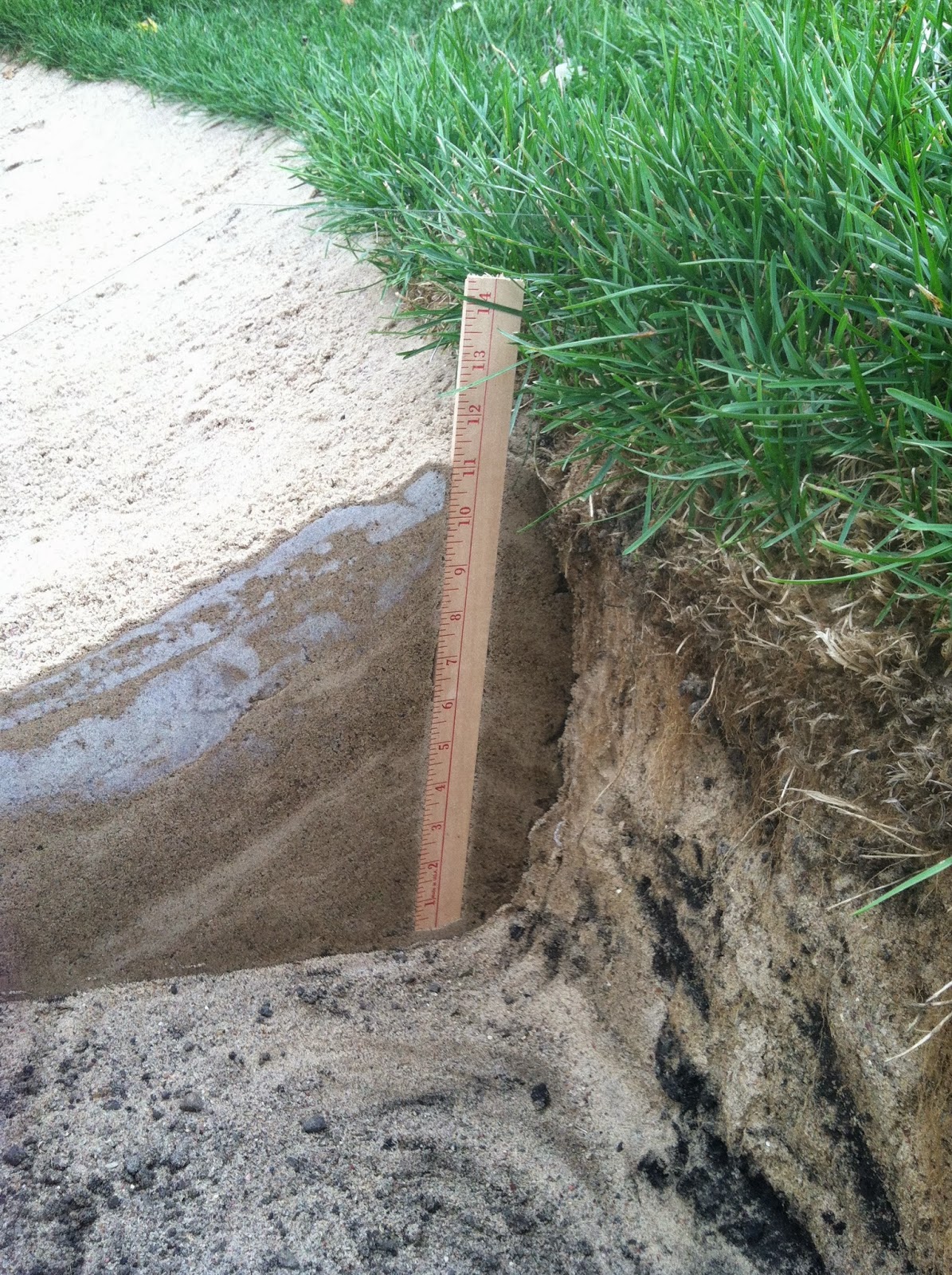
Removal of the bunker sand reveals a 90 degree angle of sub-soil at the bunker edge.  This 90 degree angle causes a deep layer of sand around the edges of bunkers.


This close up shows the deep layer of sand near the edges and the steep transition from 9" to a consistent 2"-3" of sand in the bunker flats.


Plugged lies are common in the deep layer of sand near the edges.


Once bunker sand was removed and drain lines cleaned a layer of clay was packed around the edges on the inside of the bunker.  This layer of clay will allow the bunker sand to "mirror" the bunker bottoms providing a consistent 2"-3" sand depth throughout the entire bunker.


A bunker liner was added to the center section of each bunker.  This bunker liner reduces contamination of soil into the sand and also hold the sand in place on any sloped areas during heavy rains.


Bunker sand was added and compacted.


A "view port" was left exposed to show the difference in edge construction.  The left photo shows our current bunkers with over 10" of sand near the edge.  The right photo shows a renovated edge where sub-soil is ramped to the edges allowing for a consistent sand depth throughout the bunker.


From left to right "North Face" "Best Tour Grade Signature" & "Steep Face" 


On October 5th a heavy thunderstorm dumped 2.5" of rain in a short period of time.  Notice how the sand in the middle installed with a liner didn't wash while the other 2 sands washed from the bunker edges.

Tuesday, October 8, 2013

Fall Greens Aerification Complete


Core aerification of all 18 greens is complete.  Utilizing an outside contractor and our in house staff we were once again able to complete the process in 1 day minimizing course downtime.  All open holes have been filled with sand, and I expect the greens to be fully healed in 7-10 days if the current forecast of warm temperatures holds.  Thank you for your understanding as we complete this extremely important practice.

Thursday, June 6, 2013

June Golf Course Update

May started dry but ended wet. We received a month's worth of rain in the final 2 weeks of the month for a total of 3.81".   Between the showers and storms, grounds staff was busy preparing the course for daily play while finishing spring projects.  The summer months bring a shift to the grounds department as we focus on daily maintenance and grooming while projects and improvements wait for the fall.


After the final frost in late May Assistant Bob McCallum led a crew planting nearly 1,500 flats of annual flowers throughout the golf course, clubhouse grounds and pool areas. 


Assistant Todd Vermillion marks a shamrock on the 4th green for Celtic Day.  A nice idea by Golf Pro Chris York.


Greens were "pencil tined" on Monday to create air channels during the recent wet conditions.  These 1/4" solid tines penetrate 6" deep and heal very quickly on the surface.  The air channels created allow the turf roots to breath and help the green dry down during this extended wet period.


Sand topdressing was also applied and brushed in on Monday.  We strive to topdress greens bi-weekly as weather allows to provide smooth, firm, healthy greens.


Granite Path #1 "Before" - Inconsistent width and granite depth, worn edges and ruts.


Granite Path #1 "After" - Our experiment in restoration provides a uniform width and sharp, clean edges.  We are experimenting with different equipment and methods to find the most cost effective way to revitalize and maintain Ridgemoor's 10,000 linear feet of existing decomposed granite cart paths. 


Tree vs Turf - The tree always wins the battle by shading and outcompeting the turf for essential sunlight, water and nutrients.  Nevertheless, we will continue to do our best to seed and nurture these rough areas until a long range plan of tree thinning and pruning is implemented.

Friday, May 10, 2013

Fairway Aerification

Core aerification was completed on all 18 fairways on Monday, May 6th.  Our staff worked in shifts from 3am - 7pm to complete the process in 1 day.  Tons of thatch and built up organic matter was removed from the fairways.  In the long term core aerification is key to providing healthy turf and firm playing conditions.


Three tractor mounted aerifiers began work at 3am Monday morning.  The above photo was taken at sunrise on the 5th hole.


Our 1st shift cleanup crew began dragging fairways at 8am.  The metal drags separate the sand from the organic matter and thatch returning the sand to the fairways as topdressing.


Turbine blowers followed the drag crews moving the thatch and organic matter to the edges of fairways.


A turf vacuum picks up the debris from the fairway edges.


Mountains of removed material are deposited at our dumpsite. 


Friday, May 3, 2013

Greens Aerification

Greens aerification was completed on Monday, April 29th.  Utilizing an outside contractor and our own recently purchased equipment we were able to complete the process on all 18 greens in 1 day.


Our contractor utilized 2 tractors to pull cores and windrow the pulled plugs.


Our staff then removed the plugs and applied a heavy layer of topdressing sand.  Brushes, brooms and blowers were then used to work the sand into the aerification holes.