Sunday, August 10, 2014

Renovation Week II

The second week of the Golf Course Renovation Plan brought an inch of rain which slowed production in some areas that required earth moving.  We were however able to adjust and once again have a productive week.


Covers were removed from fumigated greens early in the week.  These greens will be allowed to air out for 5-7 days before seeding operations begin.
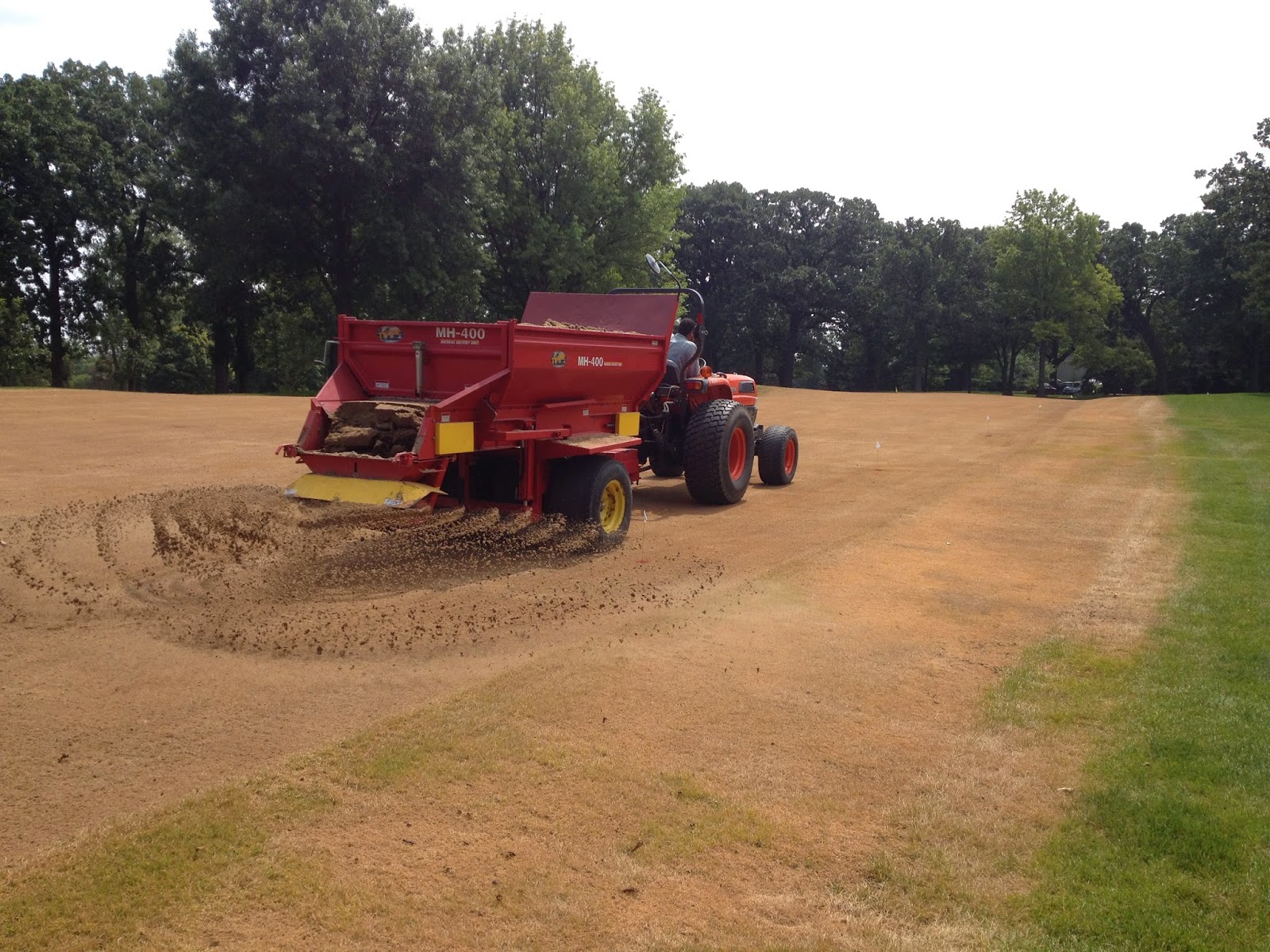

Bunker sand is removed and reused as fairway topdressing sand.


Cart path removal is underway at tee locations.  These paths will be relocated and replaced in decomposed granite instead of asphalt.


Our golf course architects made several visits to adjust and tweak the new greens and practice area.


Soil fumigant was applied to fairways.


Drainage and irrigation work is underway on the new greens.


The 3rd green irrigation and drainage work is complete.  I expect to seed these new greens by the end of August.


Friday, August 1, 2014

Renovation Week I

The weather this week has been ideal as the golf course renovation began.  Tremendous progress was made in a few short days by both TDI and RCC staff.  A glimpse of the work is outlined below.


Greens were scalped and verticut in 4 directions early Sunday morning.


Double aerification with 1" diameter tines followed.


Heavy sand topdressing.


All aerification holes were filled using drag mats and rotary brushes.


Not much grass left at the end of the day.


Green expansions were stripped of sod and cored to a 6" depth.  Drain tile from the XGD system was extended into these expansion areas when possible.


Green expansion cavities were filled with 7:2:1 mix.


Tubes were laid in a grid pattern across each green and expansion area to insure distribution of the fumigant.


Plastic covers were then installed over each green and held in place with a sod ring at the perimiter.


Methyl Bromide was then applied under the covers through the tubing.  Cover will remain in place for 5 days.


Lake excavation began on the 5th hole.


Tree removals make way for the new tees on #5.


Several trees were in very poor condition.


Fairways were sprayed with Round-up, double verticut and double aerified in initial preparation for seeding.


Fill was imported to the 3rd green site where initial shaping began.


The green cavity is already beginning to take shape.


Grab a shovel boys!  Staff began the process of removing bunker sand.  Much of the sand will be salvaged and used for fairway topdressing.

Thursday, May 22, 2014

17 Greens Open For Play!!

It has been 6 weeks since our seeding and recovery efforts began.  Patience, hard work and some warm sunny days have paid dividends.  


The 1st green on April 7th (above) and again on May 21st (below).   Still some thin areas but playable.   


The poster child for winter damage the 6th green (above) on April 7th.  That's me looking for any sign of life! 


Hard to believe this is the same 6th green a mere 6 weeks later.  Sure looks better with that flagstick! 


Wednesday, April 23, 2014

Winter Weather Part III - The Recovery

The first 2 weeks of recovery are behind us and so far progress has been very good, despite Mother Nature's determination to derail our best efforts with snowfall and frosty temperatures.  Our persistence in removing and replacing green covers on an almost daily basis along with verticutting, spiking, topdressing, fertilizing and irrigating resulted in much of the Poa annua springing back to life from winter dormancy.  Additionally all greens have been seeded with Bentgrass which is beginning to germinate.  Some of the early results are outlined below.


The Practice Putting green appeared almost completely dead on April 7th (above).  Just 12 days later much of the Poa annua has decided to break winter dormancy and spend another season at Ridgemoor.  The areas that remain brown reflect the low areas where water collected and formed the thickest ice layer, causing "suffocation" of the Poa annua.  These areas have all been seeded and we are observing germination at this point.


The 18th green was spotty at best on April 7th.  Much of the green color is Bentgrass that had no trouble surviving the winter (above).  By April 19th the 18th green was on the mend (below).


The 7th green on April 7th (above) and April 19th (below).


The front of the 7th green shows small areas where the Poa annua did not survive as of April 12th (above).


Close inspection of these thin areas on April 19th revealed the germination of Bentgrass seed!  This is a huge leap forward in the recovery process and we are noting similar results on ALL GREENS at this point! 


On April 21st the 18th green received it's 2nd mowing of the season.  One of the better greens, I expect to open this green and others in similar condition beginning early next week.


Wednesday, March 12, 2014

Winter Weather Part II

Following up on our recent blog post and letter to membership, below are some photos of our continued effort to mitigate any winter damage on greens.


After the snow was removed (see previous post) most greens were left encased in a thick layer of compacted snow and ice.  Fertilizer was applied to absorb heat and aid in the meltdown.


After just a few hours the meltdown began.  Mick inspects the 18th green (above), not a goose in sight! 


Staff cut small channels in the ice to aid in drainage of meltwater.  


Thicker ice was broken up by hand.


Skid steers were used to clear snow from the low runoff points at the edge of all greens.  Above you can see meltwater pooling near the edge of the 14th green.  It was important to provide an exit point for meltwater so we didn't reform ice as night time temperatures dipped below freezing.


Throughout the winter small 2" sample plugs have been brought into the shop and placed under a grow light.  So far results have been mixed but the information gained from these samples allows us to build a game plan for the warmer temperatures that are surely around the corner.

Thursday, February 13, 2014

Winter Weather

If you've spent the winter in Chicago I don't need to tell you the weather has been relentless.  From the "polar vortex" to constant snowfall events, sunny days on the golf course seem a long way off.  Of particular interest this winter season is the potential for winter damage to the golf course given the harsh winter weather.  While snow cover is fine and can even provide an insulating blanket to our fine turf, extended periods of ice coverage are another mater.  At this point areas of the golf course have been under continuous ice coverage since a rain event on January 13th.  Expert opinions vary but generally poa annua (our primary grass species) can survive 30-60 days under ice before death begins.  Bentgrass on the other hand can survive 90-120 days under ice coverage before damage occurs which is yet another reason for the re-grassing portion of the upcoming Renovation Plan.

Winter Injury and Turf

Several types of winter injury can occur depending on weather and grass types:  Low temperature kill, snow mold disease, winter desiccation, crown hydration and ice encasement or suffocation to name a few.  Plant protectants applied in the fall do a good job of controlling snow mold.  The covers used in the past provided protection from desiccation injury but do little to protect plants from ice encasement or crown hydration injury which are of particular concern this season.

Our primary turf type is poa annua on greens, tees and fairways.  It is this poa annua that is most concerning as we surpass the 30 day mark under ice cover.  With the long term forecast showing a slight warmup next week I have made the decision to remove the snow from greens and help Mother Nature break up and melt the persistant ice layer.  The beginnings of the process are outlined below, updates to follow next week as the weather warms...


Snow blowers and shovels are used to clear the 18" - 24" of snow from each green on the golf course.  Exposing the ice layer to sunshine and warmer temperatures next week will help speed the thawing process. 


Using a 2" hole saw core samples were removed from several greens.  These samples will be placed indoors in a greenhouse setting as test samples.


Above is a core sample from the 18th green, the ice layer is approximately 3/4" thick.  In 5-7 days we should have a good indicator of how our greens have handled this winter.

Stay tuned....